


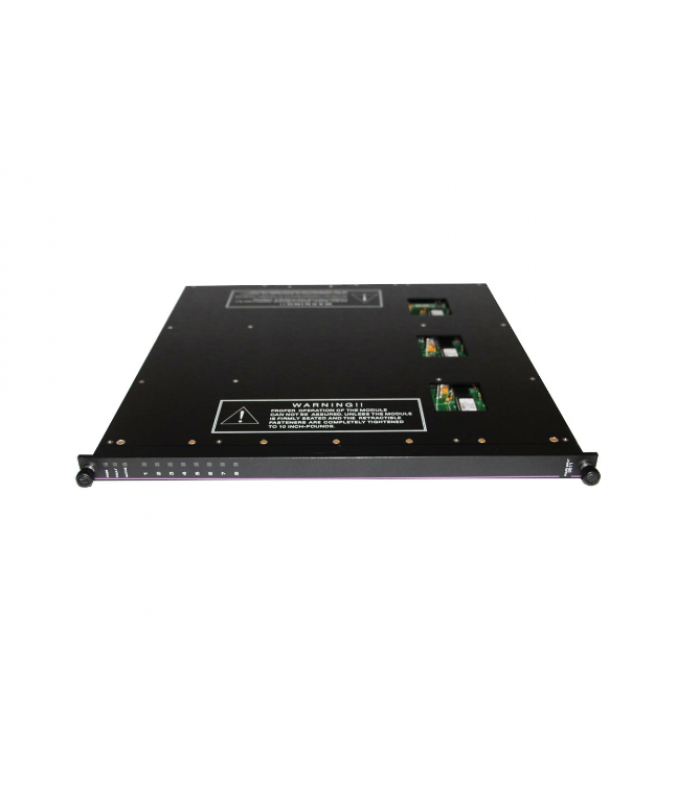
TRICONEX 3511 16-Channel Analog Input Module
- Product Code: TRICONEX 3511
- Availability: In Stock
TRICONEX 3511 Technical Specification Sheet
16-Channel Analog Input Module | TMR Safety System | Revision: 3.1 (2025)
SIL 3 Certified | TÜV Rheinland Approved | IEC 61508 Compliant
1. Product Overview
The TRICONEX 3511 is a high-density, triple modular redundant (TMR) analog input module designed for critical safety instrumented systems (SIS) in process industries. This 16-channel module accepts universal analog input signals (4-20 mA, 0-10 V, thermocouple, RTD) and provides fault-tolerant data acquisition for process variables such as pressure, temperature, flow, and level—critical for protecting personnel, equipment, and the environment in oil refineries, nuclear power plants, and chemical manufacturing facilities.
Key design features include built-in self-diagnostic (BSD) circuitry, galvanic isolation (1500 VDC) between channels and backplane, and hot-swappable construction for non-intrusive maintenance in safety-critical applications. The module is fully compatible with TRICONEX TS3000 and TRICON CX safety systems, and meets SIL 3 requirements per IEC 61508 and IEC 61511 standards.
2. Technical Specifications
| Parameter | Value | Unit |
|---|---|---|
| Number of Input Channels | 16 | Channels |
| Input Signal Types | 4-20 mA, 0-10 V, Thermocouple (J/K/T/E/R/S), RTD (Pt100) | - |
| Input Isolation | 1500 | VDC (Channel-to-Backplane) |
| Accuracy (4-20 mA) | ±0.05 | % of Full Scale |
| Sampling Rate | 10 | Hz (Per Channel) |
| Operating Temperature Range | 0 to 60 | °C |
| Power Consumption | 5 | W (Max) |
| Dimensions (H×W×D) | 229 × 102 × 305 | mm |
| Weight | 1.2 | kg |
3. Installation Guidelines
- Install the TRICONEX 3511 module only in a TRICONEX TS3000/CX chassis slot designated for analog input modules; verify the chassis backplane is powered off for non-hot-swap installations.
- Ensure the module is seated firmly in the chassis slot—engage the locking levers until an audible click is heard to guarantee a secure connection to the backplane.
- Wire analog input signals to the front-terminal block (TB) per the TRICONEX 3511 Wiring Diagram (PN: 3511-WD-001); use twisted-pair shielded cable (24 AWG minimum) for 4-20 mA signals to minimize electromagnetic interference (EMI).
- Ground the cable shield at the sensor end only (single-point grounding) to prevent ground loops; connect the module’s chassis ground terminal to the plant’s safety earth (PE) system per IEC 60364.
- For thermocouple/RTD inputs, use compensation cables (per thermocouple type) and install cold-junction compensation resistors if required by the system configuration.
- Configure the input channels (signal type, scaling, alarm limits) via the TRICONEX TriStation 1131 software (v4.8 or higher) before system power-up.
- Perform a channel self-test via TriStation 1131 after installation to verify signal acquisition and fault-diagnostic functionality for all 16 channels.
4. Maintenance & Troubleshooting
Preventive Maintenance
Perform annual visual inspections of the module’s terminal block and backplane connection for corrosion, loose wiring, or physical damage. Calibrate the module’s input channels every 24 months using a certified calibrator (e.g., Fluke 754) per the TRICONEX Calibration Procedure (PN: 3511-CAL-001).
Replace the front-terminal block (PN: 3511-TB-002) if corrosion or terminal damage is detected; replace the module’s cooling fan (if equipped) every 5 years to prevent overheating in high-temperature environments.
Common Issues & Resolutions
Issue 1: No input signal detected → Verify wiring continuity with a multimeter; check for open circuits in the sensor or cable; confirm channel configuration in TriStation 1131 matches the signal type.
Issue 2: Erratic signal readings → Check for EMI from nearby motor starters or VFDs; re-route signal cables away from power cables; verify single-point grounding of the cable shield.
Issue 3: Module fault LED illuminated → Use TriStation 1131 to read the fault code; troubleshoot per the TRICONEX 3511 Fault Code Manual (PN: 3511-FC-001); replace the module if a hardware fault is identified (hot-swap allowed for SIS with TMR redundancy).
Issue 4: Inaccurate temperature readings (thermocouple) → Check cold-junction compensation; verify compensation cable type matches the thermocouple; calibrate the thermocouple sensor with a dry-block calibrator.
Issue 5: Module overheating → Inspect the cooling fan (if equipped) for blockage or failure; ensure the chassis has adequate ventilation (minimum 10 CFM airflow); verify the ambient temperature is within 0-60°C operating range.
5. Safety Information
WARNING: This module is part of a safety instrumented system (SIS) certified to SIL 3. Unauthorized modification, installation, or maintenance may compromise system integrity and lead to catastrophic process failures, injury, or loss of life.
All work on the TRICONEX 3511 must be performed by certified TRICONEX service technicians or personnel trained in IEC 61511 SIS maintenance. Hot-swap replacement is allowed only in TMR systems with active redundancy—never remove the module from a non-redundant SIS while the process is in operation.
Disconnect the chassis power supply before performing non-hot-swap maintenance. Use anti-static wrist straps when handling the module to prevent electrostatic discharge (ESD) damage to sensitive electronic components.
Refer to the full TRICONEX 3511 Safety Manual (PN: 3511-SM-001) and TRICON TS3000 SIS Safety Guide (PN: TS3000-SG-001) for additional hazard identification, risk mitigation, and emergency procedures.
Schneider Electric (TRICONEX) | 345 Discovery Drive, San Marcos, TX 78666, USA | Tel: +1 (512) 392-2500 | www.se.com/triconex
Document ID: DOC-3511-001 | Last Updated: November 2025 | IEC 61508 SIL 3 Certified